
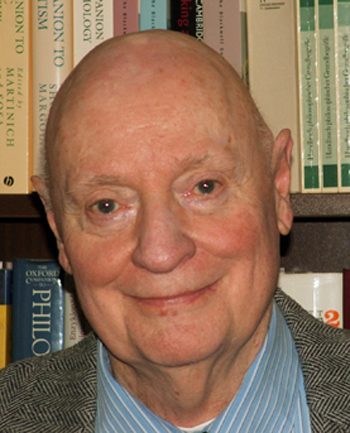
Nicholas Rescher
1928–2024 · Okänd nationalitet / Okänt verksamhetsland · filosof, universitetslärare · Priser: Officerare av Förbundsrepubliken Tysklands förtjänstorden, Helmholtz-medaljen 2016, Aquinas Medal 2007, Guggenheimstipendiet
Jämför priser på 4 böcker av Nicholas Rescher från flera bokhandlare.
Serie: SUNY series in philosophy.
Nyast: Espionage, Statecraft, and the Theory of Reporting (2018).
Billigast just nu: Paradoxes – 317 kr.
Visar 4 av 4 böcker


Böcker i ordning
Nicholas Reschers böcker i ordning efter svensk utgivning enligt Libris (Kungliga biblioteket), äldst först — 80 av 101 verk: de som går att köpa nu och de äldsta. Titlar utan länk säljs inte hos någon av våra bokhandlare just nu.
- 1958 – On the epistemologi of the inexact sciences
- 1960 – On the epistemology of the inexact sciences
- 1962 – Al-Fārābī
- 1963 – Studies in the history of Arabic logic
- 1964 – Hypothetical reasoning
- 1964 – The development of Arabic logic
- 1966 – Distributive justice
- 1966 – The logic of commands
- 1967 – Studies in Arabic philosophy
- 1967 – Temporal modalities in Arabic logic
- 1967 – The philosophy of Leibniz
- 1968 – Topics in philosophical logic
- 1969 – Essays in philosophical analysis
- 1969 – Introduction to value theory
- 1969 – Many-valued logic
- 1970 – Scientific explanation
- 1971 – Temporal logic
- 1972 – Welfare
- 1973 – Conceptual idealism
- 1973 – The coherence theory of truth
- 1973 – The primacy of practice
- 1974 – Studies in modality
- 1975 – A theory of possibility
- 1975 – Unselfishness
- 1976 – Plausible reasoning
- 1977 – Dialectics
- 1977 – Methodological pragmatism
- 1978 – Peirce's philosophy of science
- 1978 – Scientific progress
- 1979 – Cognitive systematization
- 1979 – Leibniz
- 1980 – Induction
- 1980 – Scepticism
- 1980 – The logic of inconsistency
- 1980 – Unpopular essays on technological progress
- 1981 – Leibniz's metaphysics of nature
- 1982 – Empirical inquiry
- 1983 – Risk
- 1984 – The limits of science
- 1987 – Ethical idealism
- 1987 – Forbidden knowledge and other essays on the philosophy of cognition
- 1987 – Scientific realism
- 1988 – Rationality
- 1989 – Cognitive economy
- 1989 – Moral absolute
- 1990 – A useful inheritance
- 1990 – Baffling phenomena
- 1992 – A system of pragmatic idealism
- 1993 – Pluralism
- 1994 – American philosophy today and other philosophical studies
- 1994 – Philosophical standardism
- 1995 – Luck
- 1995 – Satisfying reason
- 1996 – Instructive journey
- 1996 – Priceless knowledge?
- 1996 – Process metaphysics
- 1997 – Objectivity
- 1997 – Profitable speculations
- 1998 – Communicative pragmatism and other philosophical essays on language
- 1998 – Complexity
- 1998 – Predicting the future
- 2000 – Kant and the reach of reason
- 2000 – Nature and understanding
- 2000 – Process philosophy
- 2000 – Realistic pragmatism
- 2001 – Cognitive pragmatism
- 2001 – Minding matter
- 2001 – Paradoxes
- 2001 – Philosophical reasoning
- 2002 – Enlightening journey
- 2003 – Cognitive idealization
- 2003 – Epistemology
- 2003 – Imagining irreality
- 2003 – On Leibniz
- 2003 – Rationality in pragmatic perspective
- 2003 – Sensible decisions
- 2004 – Cognitive harmony
- 2004 – Value matters
- 2005 – Cosmos and logos
- 2018 – Espionage, statecraft, and the theory of reporting